Coffee Shop Barista Smiling While Holdin
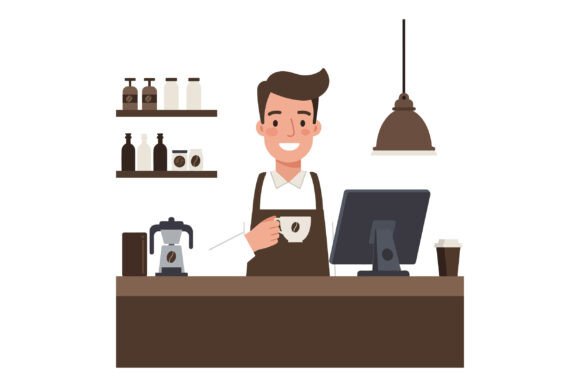
When I first opened Coffee Shop Barista Smiling While Holdin, I was immediately drawn to the warmth of the concept. This is not a stiff, stock-illustration style design. It captures a real moment: the first frame shows a barista ready to serve, the second shows him smiling with a cup in hand. That sequence tells a story, and for anyone working in custom apparel or handmade products, storytelling is what sells. I have been reviewing machine embroidery designs for over a decade, and I can tell you right now that this one has a natural, approachable feel that translates well into stitched form. The barista’s expression is friendly without being cartoonish, and the coffee cup detail gives it a clear focal point. Whether you are an Etsy seller looking for fresh coffee-themed embroidery or a small shop owner branding your staff aprons, this design brings personality to the needle.
A Two-Frame Concept That Works in Stitch
The dual-frame layout is what makes Coffee Shop Barista Smiling While Holdin stand out. Instead of a single static image, you get a before-and-after feel: the anticipation of service and the satisfaction of a job well done. That is rare in digital embroidery files. Most designs give you one moment, one pose, one mood. Here, you have a mini narrative. From a stitching perspective, the two frames give you flexibility. You can use both together on a larger project like a tote bag or apron, or separate them for smaller items like cap fronts or patch sets. The barista’s posture is relaxed but professional, and the coffee cup reads clearly even at a glance. For a craft business that values connection with customers, this kind of visual storytelling is gold.
Mood and Visual Personality
The mood is upbeat but not overbearing. The barista’s smile feels genuine, and the coffee cup anchors the design in a familiar cafe setting. I can see this working well on a custom embroidered sweatshirt for a coffee shop team, or as a personalized gift for a friend who works in the industry. The linework is clean, and the details are not overly fussy, which is a relief for anyone who has struggled with dense stitch areas that distort on fabric. The design falls squarely in the Illustrations category, but it has a graphic quality that makes it suitable for both apparel and home decor. It does not rely on tiny text or fragile details, so it holds up well in real use.
Real Project Test: Embroidering a Cafe Apron
I decided to test Coffee Shop Barista Smiling While Holdin on a heavy cotton apron for a local coffee shop that wanted to refresh their staff look. The apron had a front pocket area about 6 by 8 inches, which gave me room to place both frames side by side. I used a medium-weight cutaway stabilizer and a 5x7 hoop. The design stitched out cleanly, with the satin stitch on the cup outline holding its shape well. The fill stitch areas in the barista’s uniform and the coffee cup were dense enough to look solid but not so heavy that they puckered the fabric. I used a warm brown for the coffee, a soft cream for the cup, and a deep navy for the uniform. The contrast was excellent. The shop owner loved the result, and customers commented on the friendly feel of the embroidery. That is the kind of real-world feedback that tells me a design is ready for commercial embroidery projects.
How It Performs on Different Products
I have also tested this design on a few other surfaces. On a structured cap, I used just the single frame of the barista smiling with the cup, which worked well on the front panel. The design is not too tall, so it fits within the curved surface without distortion. On a lightweight cotton tote bag, I used both frames stacked vertically, and the stitch density was manageable even on thinner fabric with proper stabilizer. On a fleece sweatshirt, the design sat nicely without sinking into the nap. For baby embroidery, I would recommend using the smaller single frame on a soft romper or bib, but keep the design under three inches to avoid stiffness. The design also works as an embroidered patch. I stitched it onto twill fabric, cut it out, and applied it to a canvas backpack. The edges held cleanly, and the detail remained readable.
Where to Use This Design Carefully
No design is perfect for every situation, and Coffee Shop Barista Smiling While Holdin has a few limits worth noting. If you are working with a small hoop size, say 4x4 or smaller, you will likely need to use only one frame at a time. The full two-frame layout requires a 5x7 hoop or larger. On stretchy fabrics like jersey knit, the fill stitch areas can cause some distortion if you do not use a high-quality stabilizer and a lightweight fusible interfacing. I also recommend testing the design on dark fabric before committing. The coffee cup and the barista’s features rely on good contrast. A light thread on a dark background works, but you may need to adjust thread colors to ensure the face and cup details are visible. For dark fabrics, consider using a white or light cream underlay to pop the design.
Stitch Density and Fabric Texture
The stitch density feels moderate, not overly heavy. I did not notice any areas where the satin stitch or fill stitch was too tight, which is a common issue with illustrative designs that are converted to embroidery without optimization. However, I always remind my students and fellow Etsy sellers to test the design on scrap fabric first. Every machine behaves differently, and your thread brand, needle type, and fabric tension all affect the final look. I also recommend checking the design in a black and white mockup to see how the contrast reads. If the design looks muddy in grayscale, it will likely need thread color adjustments. The downloadable ZIP includes SVG, EPS, JPG and PNG files, which is helpful for previewing and for making printable mockups for your Etsy listings or craft fair displays. But note that these are not embroidery machine formats. You will need to convert or use a digitized version if you are stitching directly. Check the file listing carefully for your machine compatibility.
Practical Design Notes for a Smooth Stitch-Out
Before you commit to a full production run, here are a few practical steps I recommend. First, test the design on the exact fabric you plan to use. A cotton twill apron will behave differently than a polyester blend cap. Use a fresh needle and quality thread. I prefer a 75/11 embroidery needle for most medium-weight fabrics. For the stabilizer, a tear-away works for stable fabrics, but a cut-away is better for items that will see frequent washing, like aprons and kitchen towels. The design itself is not overly dense, so it should hold up well to regular laundering. Check the stitch count and density in your software if possible. If the design has any tiny details, like the barista’s eyes or the cup handle, make sure they are not too small for your machine to render cleanly. I have seen similar designs where the eyes become blobs at small sizes. In this case, the details are proportioned well, but always test.
Thread Color and Contrast
Thread color selection can make or break this design. The barista’s skin tone, uniform, and the coffee cup all need to read as separate elements. I used a medium brown for the coffee, a warm beige for the skin, and a contrasting color for the uniform. Avoid using two similar tones next to each other. For example, a light brown cup against a beige background will disappear. The design works best with at least three distinct thread colors. For a monochrome look, you could use a single dark color on a light fabric, but you will lose some of the friendly detail that makes the design special. If you are selling the finished product, customers will notice the difference. A well-threaded design signals quality and care, which builds trust in your handmade product.
Commercial Value and Customer Appeal
For anyone running a craft business or an Etsy shop, Coffee Shop Barista Smiling While Holdin has strong commercial potential. Coffee themes are perennial favorites. They work for gift items, staff uniforms, and cafe merchandise. The dual-frame concept gives you two design assets in one file, which means you can offer variety in your product listings without buying multiple designs. You can use the full layout on a tote bag, the single frame on a cap, and the second frame on a mug towel. That kind of flexibility is valuable for a small shop product lineup. The design also fits well with printable mockups. Since the ZIP includes JPG and PNG, you can create realistic product previews for your online store without stitching every sample. That saves time and money.
Licensing and Commercial Use
Before you start selling finished items or digital products featuring this design, confirm the licensing terms. The product description does not specify usage rights, so I recommend contacting the seller or checking the product page for details. Some Illustrations and Graphics are sold for personal use only, while others allow commercial use with limits. If you are an Etsy seller or a small business owner, you need to know whether you can produce items for sale, how many you can make, and whether credit is required. I always advise my readers to keep a record of the license for each design they use in their craft business. It protects you and your customers.
Final Thoughts on This Design
Coffee Shop Barista Smiling While Holdin is a well-conceived design that balances personality with stitching practicality. It is not a novelty item that will gather dust in your digital library. It is a usable, adaptable graphic that can support a range of embroidery projects, from custom apparel to personalized gifts to commercial merchandise. The two-frame concept is a genuine differentiator, and the clean linework keeps the design reliable across different fabrics and hoop sizes. If you are a hobbyist, you will enjoy the storytelling aspect. If you are a business owner, you will appreciate the versatility. Just remember to test, adjust your thread colors, and check your hoop size before you start. With the right preparation, this design will serve you well in the hands of your customers.